By: Craig Bagno

There’s a lot of noise in marketing right now about artificial intelligence. The breathless predictions, the existential panic, the “everything changes tomorrow” rhetoric. But before we talk about AI, we need to zoom out. Way out.
Summary:
The three eras of marketing are Logic, Emotion, and Solutions. Early marketing focused on rational proof and product performance. Later, brands competed through storytelling and emotional connection. Today, marketing has entered the Era of Solutions, where brands win by solving real customer problems rather than shaping perception. In crowded, transparent markets, relevance is earned through usefulness, clarity, and execution.
If there’s one thing the history of marketing teaches us, it’s that marketing has never been governed by marketers. Not once. It has always been governed by two external forces far larger than the industry itself:
- The means of production — how we make the things we sell.
- The means of communication — how we reach people at scale.
When production changes, what we make changes.
When communication changes, how we market changes.
Everything else is downstream.
This perspective is the backbone of the work I do at Fazer, the brand strategy consultancy where we spend an unusual amount of time studying why the industry behaves the way it does. And when you apply these two governing forces across the last century, something striking emerges:
Marketing has shifted only three times. Not dozens. Not hundreds.
Three eras.
And the industry is currently operating as if it still lives in the second.
To understand why AI isn’t the revolution everyone thinks it is — and why brands must shift toward solutions — we need to understand the eras that got us here.
Era One: The Era of Logic (1900–1950)
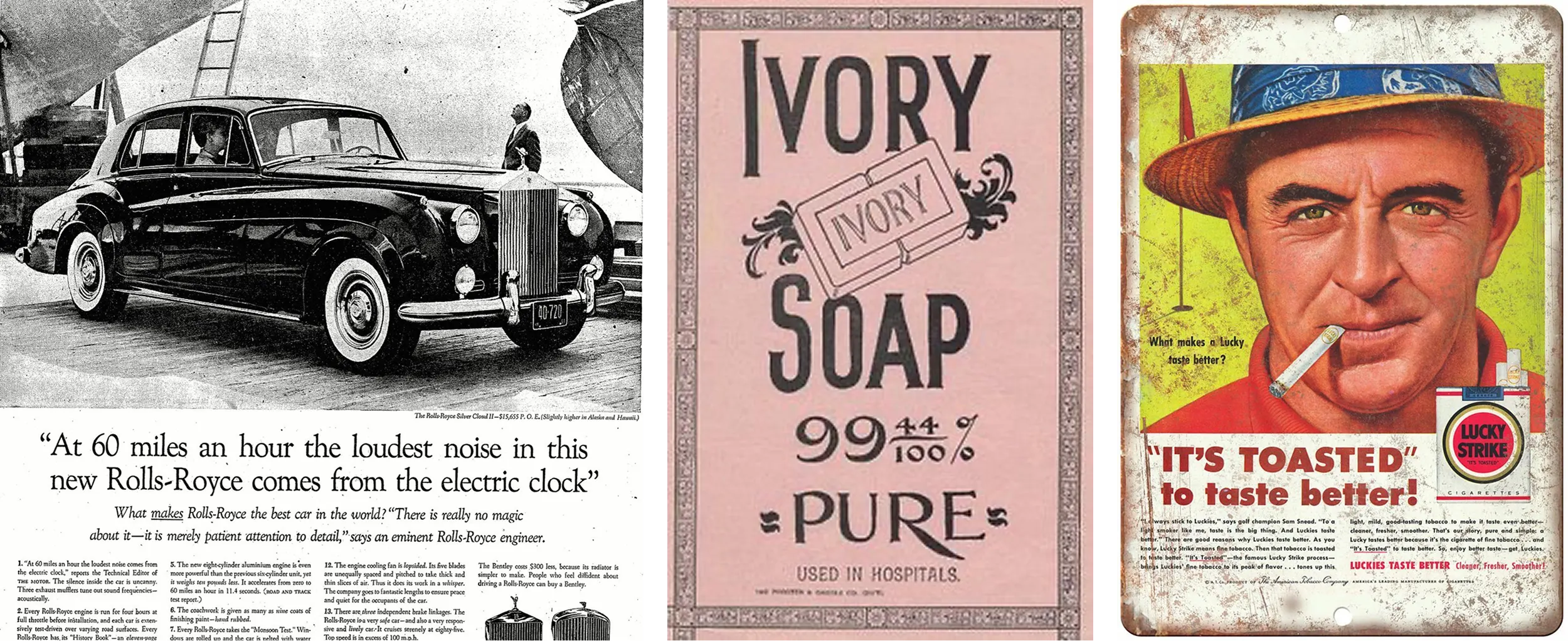
When the world was built for reason, brands won with proof: purity measured to the decimal, engineering framed as certainty, and functional superiority presented as fact rather than persuasion.
Few products. Few storytellers. Logic worked.
The early 20th century was a simple marketplace disguised as a modern one. Production was limited, so there weren’t many competing products. And communication was concentrated among companies large enough to afford paid media — a handful of national newspapers, magazines, and later radio. The result was a world where marketers could credibly claim they had the “best” product and could reliably control the story about it.
This was the age of the Unique Selling Proposition, the era of reasoned arguments and functional proof. Ivory Soap was “99.44% pure.” David Ogilvy could sell a Rolls-Royce by telling you that at 60 miles per hour, the loudest sound in the car was the ticking of the clock.
Logic worked because the world was built for logic.
Era Two: The Era of Emotion (1950–2007)
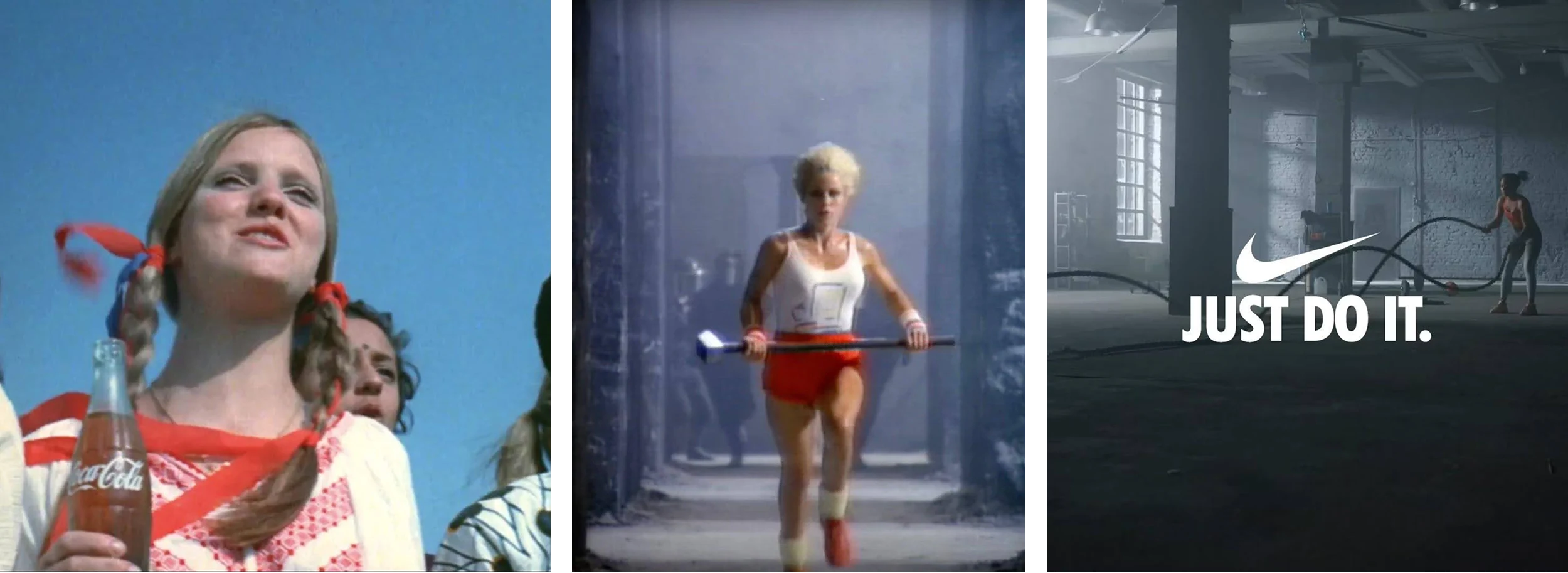
In the age of emotional monopoly, one message could move an entire nation—Coke could teach the world to sing, fitness could become aspiration, and a three-word Nike line could crystallize a cultural ideal.
Many products. One story. Emotion worked.
Television changed everything — not gradually, but instantly. Beginning in the 1950s, TV achieved mass penetration and gave marketers something they’d never had before: a single, national, emotional storytelling machine. Simultaneously, post-war manufacturing reached maturity and flooded the market with products so functionally similar that rational differentiation became impossible.
You could no longer be the best.
But you could become the most meaningful.
This was marketing’s golden age: Coke Hilltop, Nike’s “Just Do It,” Mastercard’s Priceless. Emotion, symbolism, aspiration — supported by media systems that allowed only one story to dominate.
But beneath the beauty of this era sat an uncomfortable truth:
The Era of Emotion was an era of manipulation.
Not intentionally so — structurally so.
Marketers owned the narrative because no one else had a microphone.
That monopoly would not last.
Era Three: The Era of Solutions (2007–present)
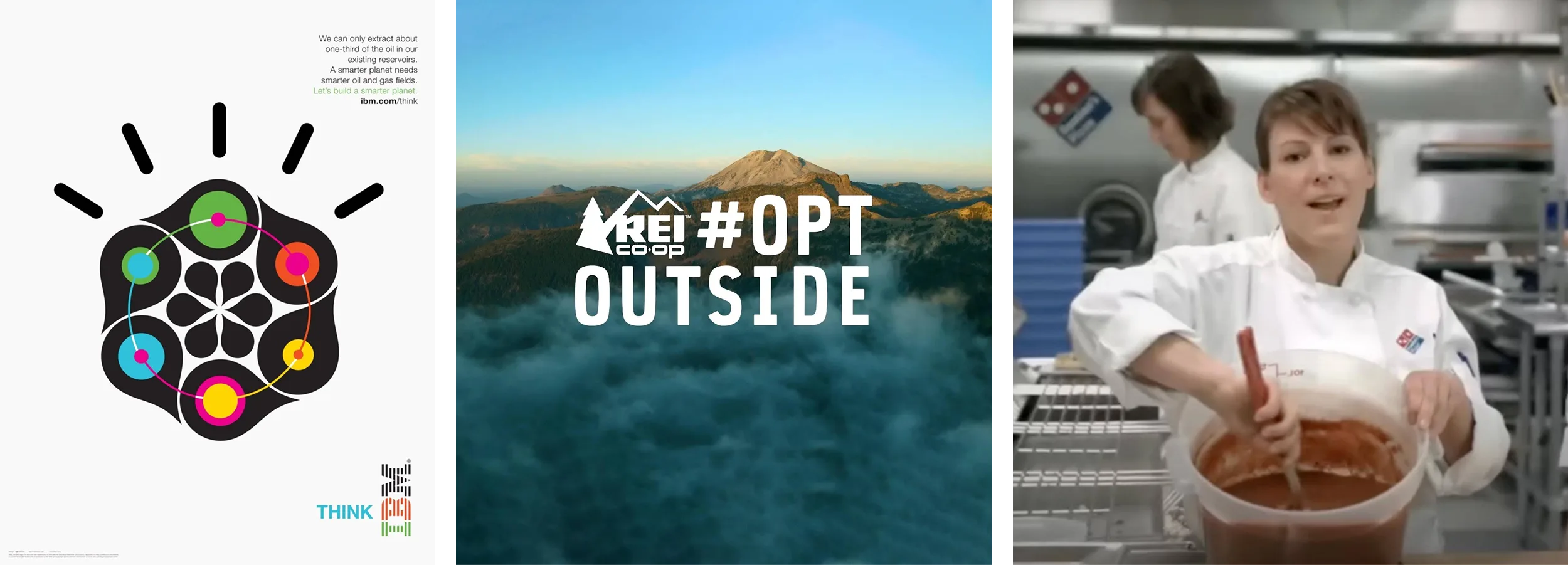
Once every brand and every consumer had a platform, storytelling lost its shield; the brands that rose were the ones that solved—fixing products, shifting behavior, and delivering outcomes the market could feel.
Too many products. Too many storytellers. Only solutions work.
We mark the beginning of this era to 2007, the year everything changed: the iPhone launched, Facebook went mass, and Twitter was born. Production shifted — suddenly anyone could make a product. Communication exploded — suddenly anyone could tell a story about it. And with those shifts, the architecture of marketing collapsed.
For the first time:
- every product had substitutes
- every consumer had a platform
- every brand narrative could be contradicted instantly
To understand the magnitude of this shift, we have to remember what came before it.
Before 2007, marketing sat out front.
For nearly a century, the brand story was the marketing story — the polished narrative that lived on top and shielded the company and the product underneath. Advertising controlled the cultural frame because nothing behind the ad was easily visible. In the Era of Emotion, that structure was the entire reason storytelling and purpose worked so well. Marketing could point the camera wherever it wanted, and the audience had no competing feed telling them otherwise.
After 2007, that architecture collapsed.
Once social platforms scaled and smartphones put the world online, the neat hierarchy of Marketing → Product → Company flattened into a single, shared plane. The ad no longer sat out front protecting what sat behind it. Everything became visible at once — the product, the experience, the leadership, the supply chain, the contradictions, the values, the missteps. The company became the story, whether the brand liked it or not.
And this is the shift most marketers still haven’t made.
We still behave as if we can control the narrative, as if storytelling can outrun reality, as if message alone can build trust. But in a world where everyone has a platform and nothing stays hidden, storytelling is no longer the layer that leads — it’s the layer that gets judged.
We love to call ourselves storytellers, but in the Era of Solutions, the public tells the story. And once that happened, something fundamental changed:
Storytelling lost its monopoly.
Differentiation lost its meaning.
And brands that solve problems now outperform brands that perform identity.
This is the era Fazer sees every day across categories — from FMCG to tech to financial services. The winning brands aren’t the ones with the prettiest narrative. They’re the ones with the clearest utility and the strongest systemic advantage.
Why Solutions Matter Now More Than Ever
There are five forces — cultural, behavioral, and economic — that make “solutions” the only viable strategy in the modern market.
1. Pain is the beginning of every customer journey
This isn’t a metaphor. It’s the Engel–Blackwell–Miniard model from 1968:
Every buying journey begins with problem recognition.
Not differentiation.
Not storytelling.
Not purpose.
Marketers love talking about “meaning,” but the truth is simple:
People buy because something hurts.
Brands win by relieving that pain.
This is the mental model we use at Fazer every day. It hasn’t failed yet.
2. Purpose and storytelling lost their monopoly
In the Era of Emotion, brand stories were unchallenged.
Today, they’re instantly contextualized, contradicted, or memed.
Your story no longer stands alone.
Your behavior is your story.
3. Differentiation is dead (as a strategy)
Not as an outcome — as a driver.
There is no white space.
Everyone can claim anything.
AI can generate “differentiation” on command.
Differentiation worked when there were few competitors and few storytellers.
That world is gone.
4. Trust is collapsing everywhere
Edelman shows brand trust at 50%.
Havas shows 78% of brands could disappear without consequence.
Ipsos shows trust as the top driver of loyalty and market share.
In a low-trust world:
Solutions feel believable.
Stories feel suspicious.
Brands that help win.
Brands that posture drift into cultural irrelevance.
5. AI accelerates the collapse of storytelling advantage
Here’s the thing:
AI is not the revolution.
AI is the accelerant.
If machines can mimic the tone and craft of brand storytelling, then:
- messaging is commoditized
- identity is imitable
- narrative advantage disappears
What remains is the only thing AI cannot fabricate:
The problem you solve.
The outcomes you deliver.
The experience you create.
The advantage you build.
This is where brands earn their place in culture.
This is where marketers return to their actual purpose.
The Future Belongs to Brands That Solve, Not Say
We are not “entering” the Era of Solutions.
We have been living in it for nearly two decades.
The problem is that most brands — and many marketers — are still behaving as if they’re in 1997.
The new playbook is simple:
- Solve the pain. Be the brand that reduces friction.
- Expose the competitor’s weakness. Judo, not karate.
- Reframe the battleground around your advantage.
- Thread the solution through the entire system — not just the ads.
This is the backbone of the de-positioning methodology we use at Fazer.
It’s not about storytelling.
It’s not about purpose.
And it’s certainly not about differentiation.
It’s about creating:
a solution the competition cannot match,
a system the customer feels,
and a clarity the market rewards.
If AI is the accelerant, solutions are the fireproofing.
In a marketplace shaped by infinite products, infinite voices, and infinite information, brands win by doing what the Era of Solutions demands:
Stop polishing the story.
Start solving the pain.
FAQ’s
What are the three eras of marketing?
The three eras of marketing are the Era of Logic, the Era of Emotion, and the Era of Solutions. Each era reflects how brands have competed for attention and preference as markets, media, and customer access have evolved.
What defines the Era of Logic in marketing?
The Era of Logic focused on rational proof points such as product features, performance, and functional benefits. Brands competed on what they made and how well it worked.
What changed during the Era of Emotion?
In the Era of Emotion, brands shifted from product logic to storytelling, symbolism, and emotional connection. Marketing focused on shaping perception rather than demonstrating function.
Why did marketing enter the Era of Solutions?
Marketing entered the Era of Solutions as digital access, reviews, and platforms made narratives easy to challenge. Brands could no longer rely on persuasion alone and had to deliver real, verifiable solutions to customer problems.
How is the Era of Solutions different from storytelling?
Storytelling shapes perception. Solutions shape behavior. In the Era of Solutions, brands win by solving meaningful customer problems better than competitors, not by telling more compelling stories.
Why does the Era of Solutions matter for modern brands?
The Era of Solutions matters because customers now have infinite choice and instant information. Brands that fail to deliver clear, useful solutions lose relevance, trust, and consideration.