

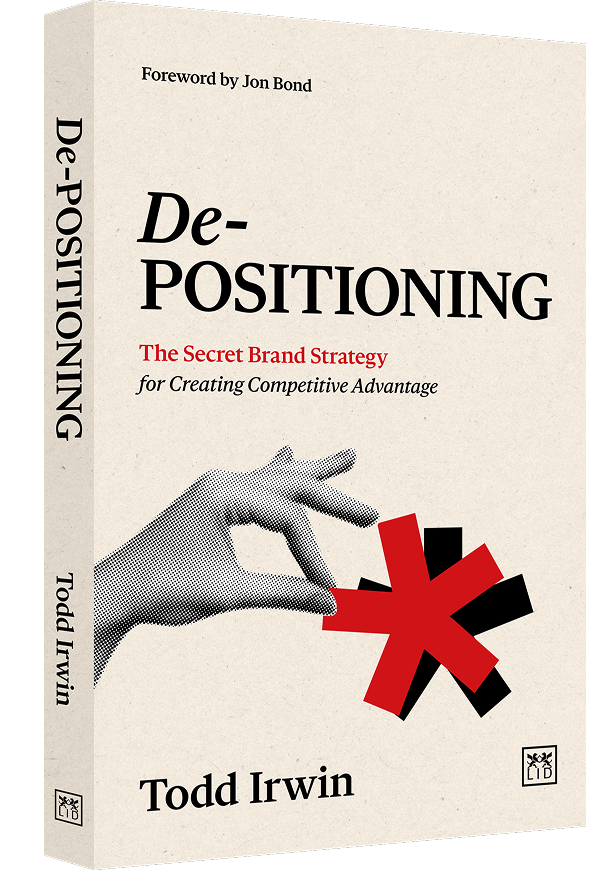







Stop differentiating.
Start dominating.
Learn the strategy that separates the winners.
For decades, brands obsessed over being “different.” Customers don’t buy “different.” They buy the brand that solves their problem: fast, clearly, and better than anyone else. De-Positioning starts where decisions actually begin: a pain point becomes urgent. Grounded in behavioral science, this book gives leaders a practical system to align product, messaging, and go-to-market around the Hero Pain Point, so you win the choice at the exact moment it’s made. If you’re ready to build a company that thinks and competes like the market’s best, this is your new operating system.
The competitive system used by market leaders.
This book reveals six principles used by the world’s most competitive brands to turn customer pain into power.
01
Champion The Customer
Customers choose the brands that understand them best
02
Be a Hero Pain Solver
Find the trigger that moves buyers from inertia to action
03
Know Competitors Weaknesses
Reframe the category so rivals look misaligned with the real problem
04
Own One Big Idea
De-positioning depends on sticking with a singular story
05
Cohere or Die
No alignment, no future – no exceptions
06
Integration Wins. Lack of It Kills
Once trust is lost, it’s nearly impossible to win back
 Jon Bond
Marketing pioneer, co-founder of Kirshenbaum Bond & Partners, and co-author of “Under the Radar”
Jon Bond
Marketing pioneer, co-founder of Kirshenbaum Bond & Partners, and co-author of “Under the Radar”
A complete system you can put to work on Monday.
Foundations
The science behind ultra-relevance and decision moments.
Hero pain point
Field methods to uncover the real buying trigger.
Strategy
Craft a de-positioning frame that out-solves, not out-shouts.
Narrative & Messaging
One-memory story that creates default choice.
Visual positioning
Design for distinctiveness in service of relevance.
Playbooks & metrics
How to run, test, and scale the system.
Built for leaders who own growth.
Create a company that competes like a category leader.
Align teams on one sharp, scalable strategy.
Turn features into decision-driving value.
Make strategy visible, memorable, and repeatable.
Think like a champion.
Win like one.
Vague “differentiation”
A single promise that wins choices
Feature lists
Pain-point solutioning that converts
Fragmented messaging
One narrative everyone can use
Awareness obsession
Demand capture at the decision moment




Start with chapter one.
Receive a PDF preview that shares the foundation for De-Positioning and why it’s a must-have.
FAQ
Is De-Positioning just positioning by another name?
No, positioning focuses on defining a brand and where it fits in a market. De-Positioning is a strategic offensive move that subtly reframes competitors’ weaknesses to make them irrelevant. Positioning asks “how can we stand out?” while De-Positioning asks “What’s the customer’s biggest pain, and how can we solve it better than anyone else?” It’s a sharper framework built for saturated markets where traditional brand positioning leads to parity, not competitive advantage.
Will this work for B2B and B2C?
Yes, this approach applies to consumer and business markets. However, as with any brand strategy, it will need to be adapted to B2B’s longer decision cycles, multiple stakeholders, and different purchase logic.
Does this conflict with Ehrenberg‑Bass Institute’s thinking?
No, Ehrenberg-Bass focuses on broad reach, mental availability, and growth through mass penetration rather than narrow positioning. De-Positioning zeros in on the most critical customer pain point and subtly makes competitors appear less relevant. While it may seem at odds with Ehrenberg-Bass’s call to “be present across many buying situations,” Fazer’s approach aligns the two, ensuring De-Positioning still supports wide category entry and broad-market reach.
Can my team implement without an agency?
Yes, if your team has the right capabilities, you can implement De-Positioning without an agency. Proper De-Positioning requires the ability to deeply analyze customer pain points, understand competitor weaknesses, and craft a clear strategic platform that aligns messaging, experience, and operations. The methodology is rigorous and requires discipline. If your team lacks brand strategy expertise, bringing in a partner such as Fazer will ensure it is executed properly.
